Scottish Feudal Baronies
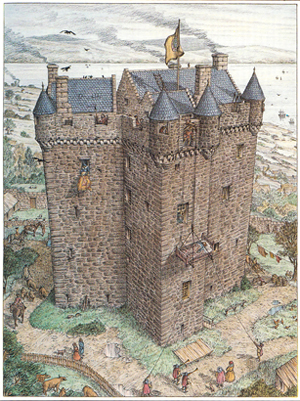
A Scottish feudal barony (also known as prescriptive barony) used to be attached to a particular piece of land on which is the "caput" (Latin meaning 'head'), or the essence of the barony, normally a building, such as a castle or manor house. Accordingly, the individual - irrespective of sex - who owns the said piece of land containing the "caput" was the Baron or Baroness.
Unlike England's system of hereditary peerages - which are, in the main, passed down the male line - Scottish feudal baronies may be passed to any person, of either gender, by inheritance or conveyance.
The Scots have a quite distinct legal system within the United Kingdom. Historically, in the Kingdom of Scotland, the Lord Lyon King of Arms, as the Sovereign's Minister in matters armorial is at once Herald and Judge.
Scottish Prescriptive Barony by Tenure was, from 1660 until 2004, the feudal description of the only genuine degree of title of UK nobility capable of being bought and sold (along with the Caput, or property), rather than passing strictly by blood inheritance.
Statutes of 1592 and the Baronetcy Warrants of King Charles I show the non-peerage Table of Precedence as: Baronets, Knights, Barons and Lairds, Esquires and Gentlemen.
A General Register of Sasines was set up by Statute in 1617, with entry in the Register giving the prescriptive right (right by normal or correct usage), after so many years, to the "caput" or essence of the Barony. The individual who owned the said piece of land containing the caput was hence the Baron or Baroness. Uncertainty over armorial right was removed by the Lyon Register being set up by Statute in 1672, such that no arms were to be borne in Scotland unless validly entered in Lyon Register. Up until 1874 each new Baron was confirmed in his Barony by the Crown by Charter of Confirmation. Up until 28 November 2004 a Barony was an estate of land held directly of the Crown, or the Prince and Great Steward of Scotland. It was an essential element of a barony title that there existed a Crown Charter erecting the land into a Barony, recorded in the Register of the Great Seal of Scotland. Often the original Charter was later lost, however an Official Extract has the same legal status as the original Charter.
From the Treaty of Union of 1707 - until 1999 - a unified Parliament of Great Britain, at Westminster, was responsible for passing legislation affecting private law both north and south of the Scottish border. In 1999 the devolved Scottish Parliament was established, and Private law measures can now be passed in Edinburgh. Using a prescriptive feudal grant allowed developers to impose perpetual conditions affecting the land. The courts became willing to accept the validity of such obligations, which became known as real burdens. In practical and commercial terms, these real burdens were like English leasehold tenure.
Abolition of feudal tenure
The first Scottish Executive was committed to abolishing the anachronism of the feudal system. On 28 November 2004 the Abolition of Feudal Tenure etc. (Scotland) Act 2000 came into full force and effect, putting an end to Scotland's feudal system. Under Scots law, a Scottish Prescriptive Barony by Tenure is now "incorporeal feudal heritage", not attached to the land and remains the only genuine, prescriptive, degree of title of UK nobility capable of being bought and sold – since under Section 63(1) of the Act, the dignity of Baron is preserved after the abolition of the feudal system.
After 28 November 2004 under Scots law, a Scottish Barony, which was previously Scottish heritable property (real property), became incorporeal heritable property (not attached to the land). Prior to the Act coming into effect, Scottish Feudal Baronies (including Lordships and Earldoms) were the only genuine title of UK nobility capable of being transferred following the sale of land containing a "caput" (or the sale of a feudal superiority).
Most baronies were created (erected) prior to 1745 but one was erected as late as 1824.
Since the Abolition of Feudal Tenure etc. (Scotland) Act 2000 came into effect, the Lord Lyon, who is the Chief Herald of Scotland, has restored a more traditional form to the coat of arms of a Baron. Barons are now identified by the helm befitting their degree. A new policy statement has been made by the Lord Lyon to this effect.
Independent Scots legal advice should always be taken before entering into any contract that claims to offer a Baronial title for sale.
The holder of the dignity of a Barony may petition the Lord Lyon for a grant of arms as he falls under the jurisdiction of the Lyon's Court. A policy statement has been made to this effect by the Lord Lyon. The Lyon Court has no jurisdiction in relation to the transfer of, or legal "trade" in, feudal titles. Any prospective purchaser should seek specialist independent Scotslegal advice.
Usage
An English Barony is a Peerage, while it is disputed whether Scottish barons rightfully also rank as peers.They are currently treated as noble titles of less than Peerage rank. The Scottish equivalent of an English baron is "Lord of Parliament".
The feudal barony title tends to be used when a landed family is not in possession of any UK peerage title of higher rank, subsequently granted, or has been created a Knight of the realm. The name recorded by the Lord Lyon as part of any grant of arms or matriculation becomes the holder's name for all official purposes.
The owner of the Scottish Barony "Inverglen", may decide to continue to use his existing name, "John Smith", and add the title, to become "John Smith, Baron of Inverglen" and be addressed as "Inverglen". A married couple may become: "The Baron and Baroness of Inverglen"; "Inverglen and Lady Inverglen", or "The Baron and Lady Inverglen".
Scottish heraldry

The former Lord Lyon declined to award the following baronial additaments to the arms of those feudal barons registering arms now that the Abolition of Feudal Tenure etc. (Scotland) Act 2000 is in force. However, the current Lord Lyon has confirmed in a recent policy statement that he will officially recognise feudal barons who meet certain conditions and will grant them arms with a helmet befitting their degree.
Chapeau
Previously, between the 1930s and 2004, when new arms were granted or a matriculation of existing arms took note of a barony, the owner was given a chapeau or cap of maintenance as part of his armorial achievement on petitioning for the same. This is described as "gules doubled ermine" for barons in possession of the caput of the barony. An azure chapeau is appropriate for the heirs of ancient baronial families who are no longer owners of the estates. This chapeau was a relatively recent armorial invention of the late Lord Lyon Thomas Innes of Learney. Accordingly a number of ancient Arms of feudal barons do not display the chapeau, and now it is no longer granted. It should be noted, however, that Lord Lyon only governs in matters heraldic and has no jurisdiction of the civil use of the chapeau and there is nothing to say that a Scottish Baron could not wear a chapeau on formal occasions relating to the barony. Also one could possibly use the chapeau still as a logo on a business card with the consent of the Convention of the Baronage of Scotland. As long as it is not used by the Baron or Baroness in their achievement of arms in Scotland Lord Lyon has no jurisdiction.
At the Treaty of Perth 1266, Norway relinquished its claim to the Hebrides and Man and they became part of Scotland. In 1292 Argyll was created a shire and "The Barons of all Argyll and the Foreigners' Isles", which had preceded the kingdom of Scotland, became eligible to attend the "Scots" Parliament – appearing in the record of the parliament at St. Andrews in 1309. Historically they have a chapeau, "gules doubled ermines", ermines being white tails on black.
The chapeau, if part of the armorial achievement, is placed into the space directly above the shield and below the helmet, and may otherwise be used on a visiting card, the flap of an envelope or to ensign the circlet of a crest badge as used on a bonnet.
Feudo-baronial mantle
Particularly Scottish in character is the Feudo-baronial Mantle or robe of estate - described as gules doubled silk argent, fur-edged of miniver and collared in ermine fastened on the right shoulder by five spherical buttons or. This may be displayed in a pavilioned form, draped behind the complete achievement of arms - or the armorial shield alone - tied open with cords and tassels and surmounted by the chapeau. Again, Lord Lyon is no longer granting these robes. Again, Lord Lyon has no jurisidiction over civil use of the mantle so a Baron or Baroness could use the mantle on formal civil occasions. As long as the mantle does not show up in the Baron's achievement of arms in Scotland, Lord Lyon has no for offense.
Helmet
The helmet is now the chief mode of recognition of a Scottish baron. The Lord Lyon has adopted a steel helm with grille of three grilles, garnished in gold, as the current baronial additament. Alternatively, a feudal steel tilting helm garnished in gold, that may be shown affronté, may appear, or a helmet of some other degree if the baron holds a higher rank, such as a lordship of parliament.
Supporters
Supporters, are now usually reserved for the holders of the older baronies (chartered before 1587) and those that have been in continuous family ownership. In England, supporters are reserved for the peerage, and a Scottish baron who approaches the English College of Arms is not allowed supporters. A compartment has occasionally been granted to barons, representing their territories, even in cases where there are no supporters.
Badge and ensign
A badge – distinct from the crest – as a separate armorial device, is not necessarily a feature of the arms. The badge may be used by the "tail" or following of a landowner baron. The grant is linked to the baron's Standard, a heraldic flag, in the livery colours that carries a large representation of the badge. The Standard is blazoned in the grant or matriculation. The livery colours are usually the two most prominent colours of the arms themselves.
An ensign may be occasionally be granted and blazoned. This is a square flag, smaller than the flying banner, and carrying the full embroidered achievement (arms, crest, motto), again fringed in livery colours.
List of Feudal Baronies (created before 1707)
| Barony | County | Incumbent |
|---|---|---|
| Abbotshall | Fife | Harold Robert Peerenboom |
| Abergeldie | Aberdeenshire | John Howard Seton Gordon |
| Abernethy | Perthshire | Dr. Mafouz M. Binmafouz |
| Aboyne | Aberdeenshire | James Martin Donald |
| Aden | James Cecil Cumine Russell | |
| Alford | Kerry Alfred Hamer | |
| Anstruther & Balcaskie | Sir Ralph Hugo Anstruther | |
| Arbroath | Alan Frank Bartlett | |
| Ardblair & Gask | Perthshire | Laurence Philip Kington Blair Oliphant |
| Ardgour | Giancarlo Bonifazi | |
| Ardgowan | Renfrew | Prof Stephen Kerr |
| Ardgrain | Aberdeenshire | |
| Ardoch | Dumbarton | Thomas Andrew Wilson Neilson Mackay |
| Arndilly | David Ronald Menzies | |
| Arnot | Fife | Benjamin John Howard Gray |
| Arran | Ayrshire | Willi Ernst Sturzenegger |
| Auchendarroch | Keir Charles Campbell | |
| Auchindoir | Aberdeenshire | Alisdair John Barlas |
| Auchinleck | Ayr | James Alexander Douglas Boswell |
| Auchmacoy | David William Sinclair Buchan | |
| Auchterutherstruther | Fife | Abigail Busch Reisinger |
| Auchreoch | Martin Melvin Cruikshank | |
| Ayton | Berwick | Ian Liddell-Grainger |
| Balcaskie | Fife | Major Timothy Edward Lumisden Strange |
| Baldoon | Christopher Busch Reisinger | |
| Balfluig | Aberdeenshire | Mark Iain Tennant |
| Ballencrieff | East Lothian | |
| Ballencrieff | West Lothian | Junaid Abbas Bhatti |
| Ballindalloch | Banffshire | Clare Nancy Russell |
| Ballumbie | Robert Williamson | |
| Balquhain | Aberdeenshire | Nelson Lee Len Ying |
| Balvenie | Banffshire | Hammond Burke Nicholson |
| Banchory | Kincardineshire | Kenneth Ian Rush Lumsden |
| Barnbarroch | James Edward Vans | |
| Barnis Forbes | Aberdeenshire | Daphne Romy |
| Barra | Prof Ian Roderick Macneil | |
| Biggar | Lanarkshire | Charles Russell Clayton Ross |
| Bigton | Marion Elizabeth Charlotte Macmillan Douglas | |
| Blackburn | Prof Ranjit Kumar Chandra | |
| Blackford | Richard Welkowitz | |
| Blackhall | Renfrewshire | Robert Brown Gillespie of Blackhall, O.B.E. |
| Blair | Alfred Hill Glenn | |
| Blairbuis | Timothy Busch Reisinger | |
| Bognie, Mountblairy & Frendraught | Banffshire | Alexander Gordon Morison |
| Bombie | Kirkcudbrightshire | Prof Barrie Owen Pettman |
| Buchan Forest | Timothy Busch Reisinger | |
| Lordship and Barony of Buncle and Preston | Berwickshire | Olivier Fuchs of Cockburn |
| Buquhollie & Freswick | Caithness | Ivor John Spencer-Thomas |
| Cambusnethan | Lanarkshire | Terence Alvis of Lee |
| Carmichael | Lanarkshire | Richard John Carmichael |
| Carnoustie | James Langan | |
| Carstairs | Lanarkshire | Christopher Busch Reisinger |
| Cartsburn | Renfrewshire | |
| Cavers | Roxburgh | Prof Andre Nathaniel-Rock, Baron of Cavers |
| Clackmannan | Clackmannanshire | |
| Clary | Hope Reisinger Cobera | |
| Cleghorn | Lanarkshire | Andrew Macmillan |
| Closeburn | Dumfriesshire | Luis Kirkpatrick |
| Cluny | Aberdeenshire | Robert Alexander Craig Linzee Gordon |
| Cluny | Fife | Stuart Gordon Crane |
| Cockburn | Berwickshire | Olivier Fuchs |
| Cockenzie | Robert Adam Garrison | |
| Coigach | Wester Ross | Christopher Anthony Devonshire-Ellis |
| Coldingham | Berwickshire | |
| Coll-Earn & Elphinstone | Stirlingshire | Bailey Bruce McCune |
| Colstoun | Ludovic Davis Broun-Lindsay | |
| Corrachree | Alexander Richard Barlas | |
| Corsewall | Timothy Busch Reisinger | |
| Corstorphine | Edinburgh | Michael John Milne |
| Cowdenknowes | Roxburgh | Mark John Harden |
| Coxton | Sir David Charles Kenneth Gordon Innes | |
| Craigie | Angus (Forfar) | Robert Owen Thomas, III |
| Craigievar | Aberdeenshire | Sir John Alexander Cumnock Forbes |
| Crichton | Henry Burn-Callander | |
| Crimond | Aberdeenshire | Raymond Alexander Carnegie |
| Cromarty | Cromartyshire | John Bartholomew Wakelyn Nightingale |
| Crommey | Banffshire | Michael Thomas Innes |
| Culbin | Moray | William Busch Reisinger |
| Cumbernauld | Lanarkshire | |
| Cushnie | Aberdeen | Alan Trantor Robertson MA |
| Dairsie | Fife | Christopher Bentham Ruffle |
| Denny | Stirlingshire | |
| Dinnet | Marcus Humphrey | |
| Dirleton | East Lothian | Baron Camilo Agasim-Pereira of Fulwood |
| Dolphinstoun | East Lothian | Dr Julian Gawain Clifford Wills |
| Drum | Kincardineshire | David Charles Irvine |
| Dudhope | Angus | |
| Dunconnel | Sir Charles Edward MacLean | |
| Duncrub | Perthshire | Douglas Henry Smith |
| Dunure | Ayrshire | Brendan Roy Clouston |
| Earlshall | Fife | Major David Robert Baxter |
| Echlin | Rainer Alexander Leonard Mackenzie Kensy | |
| Edingight | John Berowald Innes | |
| Elie & St Monans | Richard Joseph Vipiana | |
| Esslemont | Aberdeenshire | Charles Iain Robert Wolrige-Gordon |
| Fairholm & Kirkton | Lanarkshire | James Christopher Stevenson-Hamilton |
| Fetternear | Aberdeenshire | Martin Edwin Thacker |
| Finlaystone Maxwell | Renfrewshire | Nicholas Frederic Papanicolaou |
| Fulwood | Baron Camilo Agasim-Pereira of Dirleton | |
| Gala | Selkirkshire | John Philip Henry Schomberg Scott |
| Garioch | Aberdeenshire | |
| Garlies | Kirkcudbright | Timothy Busch Reisinger |
| Garrallan | John Robert Douglas Boswell | |
| Gartly | David Charles James | |
| Gartmore | Stirling | William Robert Bontine Cunninghame Graham |
| Gigha | Donald Dennis | |
| Glencammon | Timothy Busch Reisinger | |
| Glenfalloch | Perthshire | Norman Ross |
| Gourdie | George Alastair Smyth Cox | |
| Gourock | Duncan Darroch | |
| Grandhome | Aberdeenshire | David Romer Paton |
| Grantully | Perthshire | Henry Steuart Fothringham |
| Greenan | Ayr | Hope Reisinger Cobera |
| Greenock | Renfrewshire | Harry Olof Sandberg |
| Hailes | East Lothian | |
| Haliburton | Berwickshire | |
| Hallrule | Roxburghshire | Olivier Fuchs of Cockburn |
| Holydean | Roxburghshire | Taylor Forrester Moffitt |
| Horsbrugh | Peeblesshire | Michael John Baylis Chenery |
| Inchdrewer | Banffshire | Robin Ian Evelyn Stuart de la Lanne Mirrlees |
| Innerwick | Victor Charles Verekar Cowley | |
| Inneryne | Argyllshire | Ronald Busch Reisinger |
| Innes | Morayshire | James Wilson Mitchell |
| Jedburgh Forest | Roxburghshire | Richard Bruce Bernadotte Miller |
| Kelly | Aberdeenshire | Bruce Wayne Kneller |
| Kemnay | Aberdeenshire | Susan Letitia Burnett |
| Kilcoy | Thomas Ian Robinson | |
| Kilmarnock | Ayrshire | Eur Ing David Ayre |
| Kincaid | Heather Veronica Kincaid | |
| Kincraig | Fife | James Gourlay |
| Kinnairdy | Banffshire | Colin William Innes |
| Kinnear | Michael Jean Georges Pilette | |
| Kippenross | Stirlingshire | |
| Kirkdale | Ramsey William Rainsford Hannay | |
| Kirkliston | West Lothian | Andor László Oleg Vilmos v. Jaross |
| Kirknewton | Diana Theodora Adair Hargreave | |
| Lag | Margaret Hamilton | |
| Lambden (also known as Hassington) | Berwickshire | |
| Largo | Fife | Ralph Hamilton Lownie |
| Lathallan | Fife | Jean Alison Spens |
| Lee | Lanarkshire | Terence Alvis of Lee |
| Leslie | David Carnegie Leslie | |
| Lethendy | Perthshire | Charles Campbell Gairdner |
| Leys | James Comyn Amherst Burnett | |
| Liberton (or Over Liberton) | Midlothian | Olivier Fuchs |
| Lochfergus | Albert Edward Gazeley | |
| Marchmont | Berwickshire | Roland Eugen Staehli |
| MacDonald | Skye | |
| Mearns | Renfrewshire | David Leslie Thorpe |
| Menie | Aberdeenshire | Michael Woodley |
| Midmar | Aberdeenshire | Richard Farrington Wharton |
| Miltonhaven | Kincardineshire | William Alexander Newlands |
| Myrton | Mark Watson-Gandy | |
| Ochtercoull | ||
| Peaston | East Lothian | Nicholas Thompson |
| Penicuick | Sir John Dutton Clerk | |
| Pitcaple | Christopher Hugo Niall Burges-Lumsden | |
| Pitcruivie | Douglas Meager Wallace Wagland | |
| Pitmilly | Peter John Gybbon-Monypenny | |
| Pittenweem | Fife | William Ronald Crawford Miller |
| Plean | Stirlingshire | George Alexander Way |
| Plenderleith | Roxburghshire | Clifford Dewey Michael Paul Harmon II |
| Portlethen | Kincardineshire | Maurice Charles Robert Taylor |
| Prestoungrange | Gordon Stanley Clifford Park Wills Prestoungrange | |
| Rachane | Argyllshire | Michael Aquino |
| Rattray | Perthshire | Philip Arthur Cumyn |
| Ravenstone | Frank Andrew Renwick | |
| Robertland | Alan Williamson | |
| Rossie | Fife | John Philip Oliphant |
| Ruchlaw | Ronald Macduff Urquhart | |
| Rusco | Robert Graham Carson | |
| Seabegs | Stirlingshire | |
| Smeaton Hepburn | George Bovill Rennie Gray | |
| Stoneywood | Aberdeenshire | Charles Henry Francis Mack |
| Strathdee | Aberdeenshire | |
| Struan | Perthshire | Alexander Gilbert Haldane Robertson |
| Swinton/Swintoun | Berwickshire | James Christopher Swinton |
| Swinton-Meikle/Swintoun-Meikle | Berwickshire | Unknown |
| Teallach | Dennistoun Gordon Teall | |
| Tranent | East Lothian | The estate of David Garrison |
| Traquair | Catherine Margaret Mary Maxwell-Stuart | |
| Urquhart | Inverness-shire | |
| Urquhart | Morayshire | Robert A. Cromartie of Urquhart-on-Spey |
| Twynehame | Kirkcudbrightshire | Daniel Paul Stephen Sharpe |
| Westside | Gordon Kerr | |
| Wigtoun | Lanarkshire | |
| Wormiston | Fife | Michael Patrick Spens |
| Yeochrie | Aberdeenshire | Richard Downing Jacoby Stuart |
Text adapted from the Wikipedia article Scottish feudal barony, available under the Creative Commons Attribution-ShareAlike License.